
The Empty Cross


Walking into a Christian church, one of the cues that helps to tell you whether you are in a Roman Catholic church or Protestant church is the presence of either the crucifix (Catholic) or the cross (Protestant). The crucifix, displaying the crucified Jesus, often hangs above the altar, while the bare cross more often than not sits on the altar table or on a shelf behind it. Commonly this difference is explained as signifying that, while Catholics focus on Good Friday, on Jesus’ crucifixion, Protestants emphasize Christ’s resurrection on Easter Sunday.
Whatever truth that explanation might retain, the fact is that the symbolism is not so simple. The empty Cross does not point explicitly to the Resurrection. It tells us only that Jesus’ body is no longer there on the cross; it’s been removed. More than the empty cross, it is the image of the empty tomb that speaks more directly of Easter and resurrection. The empty cross is rather a symbol of Holy Saturday, when Jesus had been removed from the cross and placed in the tomb. It stands as an indicator of the reality of Jesus’ death, of His sharing in “our mortal coil.” The empty Cross only an implicit sign of impending resurrection. It suggests that the Cross is not only a symbol of hatred, violence and inhumanity: it says that the Cross is about something more.
But the empty Cross instructs us not to jump too quickly to the Resurrection, as if the Resurrection were a trump card that somehow absolves us from suffering. The Resurrection is not a divine ‘get-out-of-jail free’ card that immunizes people from pain, suffering or death. To skip too quickly to the Resurrection runs the risk of trivializing people’s pain and promises a quick and direct path through suffering that reduces the reality of having to live in pain and endure it at times. For people grieving, introducing the message of the Resurrection too quickly cheapens or nullifies their sense of loss.
While the Christ-laden Crucifix reminds us that we cannot avoid suffering and death, the empty Cross assures us that, because of Jesus’ death, the meaning of pain, suffering and our own death has changed, that these are not all-crushing or definitive. The empty Cross says that the way through to Resurrection must always break in from without, outside of us, to come as something new, that it cannot be assumed in advance of suffering or seized upon as a panacea to pain. In other words, the empty Cross is ultimately, fundamentally a sign of hope. It tells us that the new life of God surprises us, comes at a moment we cannot expect, and reminds us that experiences of pain, grief and dying are themselves suffused with the presence of Christ, the One Who was crucified and is now risen.
_____________________________________________
Above is a contemporary painting of the empty Cross, by the Italian painter Ottavio Mazzonis (1921-2010). In the painting, seven figures are gathered at the foot of the Cross. A cloth (shroud?) hanging where Jesus had been. Three figures stand at the left, all men: two gazing downward and one upward to the cross. This group is mirrored on the right by three other figures: a man peering at a book, a young woman looking at him, and a third man looking out to the viewer. A further figure crouches at the bottom, his head turned downward, into the crook of his arm.
None of these figures in the scene are named; and since the Gospels do not record any such gathering of disciples at the foot of the cross, we cannot identify them that way. However, the symbolism the artist makes use of helps us to understand who these figures are and what their presence here at the cross means.
Indeed, this painting is a wondering example demonstrating for us how to “read” a Christian painting. From the beginning of Christian art, artists have faced the challenge of portraying biblical characters in a way that everyone, even the illiterate, could recognize. As there were no cameras at the time of the crucifixion and no one left any description of their physical appearance, there can be no certainty of how the saints actually looked. The scene itself, the action depicted, might suggest which saints are present, but more often than not, painters would rely on conventional symbols to indicate identity the saints.
For example, the four evangelists—Matthew, Mark, Luke and John—are commonly associated respectively with four animals: a man/angel, a lion, an ox, and an eagle. These associations go back to St Jerome in the 4th/5th centuries and derive from the book of Ezekiel, who had a vision of God in the midst of these four “living creatures.” We meet the four creatures again in the 4th chapter of Revelation: “…the first living creature like a lion, the second living creature like an ox, the third living creature with the face of a man, and the fourth living creature like a flying eagle…”
The reasoning for these symbols is commonly given thus: Matthew’s symbol is a man because he begins his Gospel with Christ’s human genealogy, focusing on Christ the Man. Mark is represented by a lion because his Gospel starts off with a roar. Right away in the first chapter, we are confronted with the fiery words of St. John the Baptist, the “voice of one crying in the wilderness.” Luke is accompanied by an ox, an animal of sacrifice. This is because the first event he recounts is the apparition of the angel Gabriel to Zechariah, the father of John the Baptist. Zechariah, a priest, is offering sacrifice to God in the temple when Gabriel appears to announce the impending birth of his son John the Baptist. And an eagle is the companion of John, because in his Gospel, John’s account “soars” above earthly events to contemplate the Divinity of Christ. His narrative begins with these sublime words: “In the beginning was the Word, and the Word was with God, and the Word was God.”
Four of these figures in this painting are identified this way. At the feet of two of the figures on the left are an ox and a lion (Luke and Mark). On the right, closest to the cross is a human/angel looking at Matthew. And below at the center is John, accompanied by an eagle. Notice that all four have books (Gospels) in their hands. John’s is actually on the ground at his feet. Instead, he is looking inward, reflective of the mystical character of his Gospel.

Two other figures in this scene remain unaccounted for. In addition to the four evangelists, the two most important saints in Christian art and spirituality are St Peter and St Paul. Peter is often associated with keys (the Keys of Heaven), which symbolizes the authority Jesus gave Peter to “bind and loose” on earth, as mentioned in Matthew 16:19 and 18:1.
Meanwhile, Paul is identified by his holding a sword. The sword represents the power of the Word of God, which he proclaimed through his writings and teachings. Paul writes in Ephesians, “And take the … sword of the Spirit, which is the word of God” (Ephesians 6:17). The author of the letter to the Hebrews, who is traditionally believed to be St. Paul, uses a similar analogy and further explains why the word of God is connected to a sword, “For the word of God is living and active, sharper than any two-edged sword, piercing to the division of soul and spirit, of joints and marrow, and discerning the thoughts and intentions of the heart” (Hebrews 4:12). Additionally, the sword symbolizes the instrument of his martyrdom, as he was traditionally believed to have been beheaded. Hence, the two remaining figures are identified as St Peter
and St Paul.
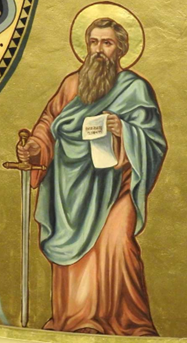
And yet these six saints are not standing just anywhere, in a non-descript place, but at the foot of the empty Cross. In this context, we understand that each of them in their own way is a witness to Jesus’ death and resurrection, and each has to try to make sense of, to respond to the reality of the Cross, to Jesus’ death and resurrection. Their answers, their accounting of the Easter mystery, are given in the Gospels and the Epistles (letters), which came to make up the New Testament. These writings, born of their experience of the crucified and risen Christ, are the center, the focus of the New Testament, and of the Bible in general. Indeed, the title of this painting, “The Catholic Church,” reminds us that our life as Christians, Catholic and Protestant alike, stems from this miraculous event and consists of responding to it in our lives, in our words and deeds.


Comments